What Balance Conceals
I was spending time with my five-year-old goddaughter, Madison. She’s the kind of child who rarely accepts defeat. Curious. Determined. Completely convinced that there’s always a way.
The house had become unusually quiet. Parents, grandparents, and godparents know that silence is rarely a sign of rest. It usually means discovery or more than that! Trouble!
I followed the silence until I found her sitting in the office. Only her little feet were visible, dangling from the oversized chair.
"Madison," I called.
She slowly turned toward me.
A milk mustache framed her smile. Cookie crumbs covered her face. Tiny fingers danced across the keyboard. Without looking away from the screen she replied,
"I can't talk right now, Mama Leelee. I'm working."
I laughed.
Then I sighed.
She's already learning that work has a way of following us even in the middle of our milk and cookies.
Perhaps that's exactly what we've taught her. Obviously, she’s been watching.
For years we've been told to pursue work-life balance as though life can somehow be divided into perfectly equal pieces.
Career.
Family.
Health.
Friends.
Purpose.
Rest.
Each receiving an equal share. It sounds beautiful doesn’t it? But also sounds impossible. .
The older I've become, the less I know balance exists.
Our lives aren’t lived in equal portions.
Business owners.
CEOs.
Parents.
Caregivers.
Community leaders.
Those entrusted with building something bigger than ourselves lives aren't lived in equal portions.
Some seasons demand more from our work. Others demand more from our families. Sometimes our health quietly moves to the front of the line without asking permission.
Life isn't balanced. Life moves.
For a long time I believed balance was something I simply hadn't mastered. Then one day I realized I had been chasing the wrong idea. Balancing was asking to distribute our attention equally. But alignment asks us to direct our attention intentionally. And those are very different pursuits.
Alignment begins with one question.
What do I really want? And no, not what others expect, or what success tells me I should want or what looks impressive from the outside.
What do I actually want my life to produce?
When I began asking that question honestly, my decisions changed.
I wanted my parents to experience dignity and joy in their later years. I wanted Madison and all the children in my life to know they were deeply loved. I wanted the businesses I served to thrive long after I left the room.
And none of those desires required equal time.
They required intentional choices.
One lesson stands above the rest.
When my father needed more support than I could physically provide, I realized something uncomfortable.
I could continue believing that my presence was the only acceptable form of love. Or I could build a community of care around him. One belief exhausted me. The other aligned with what I truly wanted.
My father wasn't asking for more of my hours. He was asking for a better quality of life, and those are not always the same thing.
I've come to believe we ask ourselves the wrong questions.
Instead of asking,
How do I balance everything?
Perhaps we should ask,
Is my life aligned with what matters most?
Because those questions lead to very different answers.
Alignment asks:
Does this require my presence?
Could someone else do this better?
Am I spending my energy where it creates the greatest impact?
What am I holding onto simply because I believe I should?
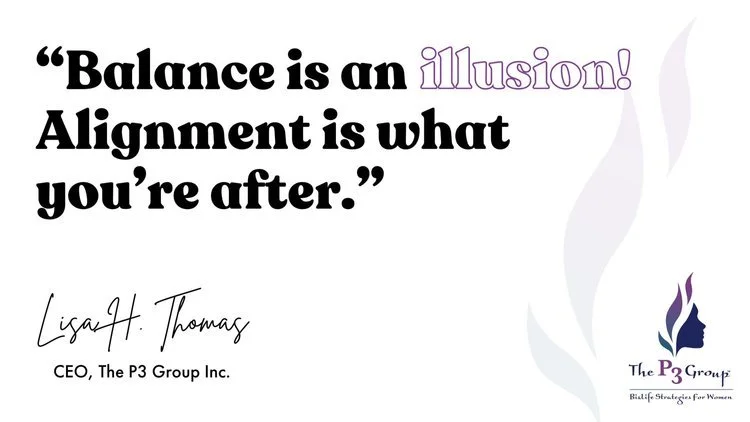
Balance measures time. Alignment measures intention.
Balance creates guilt because every area never receives equal weight. Alignment creates peace because every decision serves the life you're trying to build.
I've stopped chasing balance. Not because I don't value my family. Not because I love my work too much. But because life was never designed to stand perfectly still.
It was designed to move. To stretch. To require discernment. To invite us to decide, over and over again, what matters most.
Perhaps that's why I still think about Madison. She reminded me that work has an uncanny way of finding us, even when during milk and cookies.
The question isn't whether work belongs there. The question is whether everything else in our lives is aligned with what we truly want.
Because when alignment replaces balance, you stop trying to hold everything equally.
And you begin building a life where everything belongs.
Author's Note: I first wrote about the myth of balance in 2014. Since then, conversations about work-life integration, harmony, and intentional living have become far more common.
Revisiting these ideas reminded me that while the language has evolved, the deeper question remains the same: What are we really trying to achieve?
This essay reflects how my thinking has deepened over the years.