
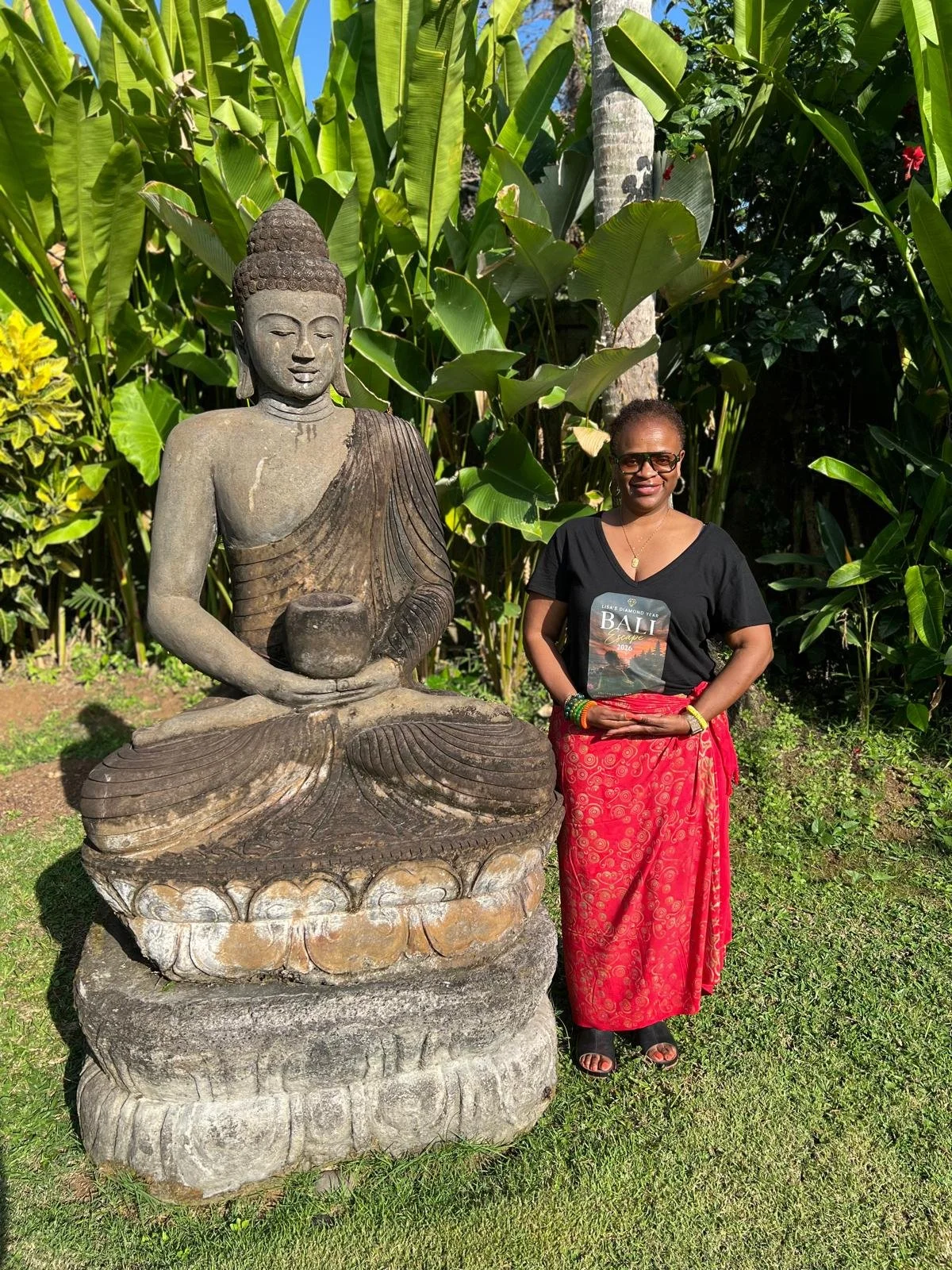
I recently found myself standing beside a Buddha statue after an experience I would not have predicted being part of my journey.
Earlier that day, I had received a blessing from a Hindu spiritual leader.
No, I have not changed religions. But I do practice allowing myself to enter spaces that are unfamiliar to me.
I have found that doing so opens the world in ways I might never have considered. There is something interesting that happens when you've lived long enough to become comfortable with what you know.
Over time, almost without realizing it, we settle into routines and beliefs. Preferences. Ways of working, thinking, and interpreting the world.
Some of them become the very things that help us succeed.
But life lived, and the data I have observed along the way, have taught me that what makes us successful can also become what keeps us from seeing.
Success has a way of confirming what we already believe. If something has worked for twenty or thirty years, why question it?
If the people around us think similarly, why venture outside the conversation? If our routines have carried us this far, why disrupt them, right?
Well because sometimes familiarity conceals.
It can conceal another perspective, another way of understanding, another question we haven't thought to ask, or perhaps even something about ourselves.
Standing there that day did not require me to abandon what I believe.
It required me to become curious about something I didn't understand.
There is a difference.
I have come to believe that conviction and curiosity can occupy the same space.
We can know what we believe and still listen.
We can be grounded and still explore.
We can encounter traditions, people and ideas different from our own without surrendering what grounds us.
In fact, sometimes differences reveal what familiarity cannot.
Leadership has taught me the same lesson.
The longer we lead, the easier it becomes to mistake experience for complete understanding.
Over time, we develop instincts, patterns, systems, and routines that have served us well. And because they serve us well, we rarely think to question them.
Some we developed ourselves. Others were handed to us long before we were old enough to question them.
But every now and then, something unfamiliar interrupts the pattern and asks us to look again.
And those moments matter.
Because what we fail to see eventually finds its way into the decisions we make.
We cannot consider what we refuse to examine. We cannot discern what we have already decided is not worth seeing.
Sometimes growth begins with the willingness to look again, rather than the need to know more.
The greatest threat to growth is not always failure.
Sometimes it is becoming so comfortable with what has worked that we stop noticing what else might be possible.
That day, I did not leave with a different religion.
I left with a wider window.
And perhaps that is one of the gifts of stepping outside the familiar.
Not that we must change what we believe.
But that we remain willing to see what our routines, and yes, sometimes even our success, have concealed.
See. Discern. Endure.